
Why Traditional Excavation Is Risky for Saudi Arabia’s Mega Projects
Traditional Excavation as a Strategic Risk in Saudi Mega Projects
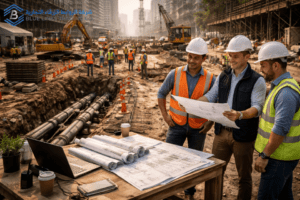
For decades, excavation has been treated as a routine construction activity—an operational step delegated to site teams and managed within standard schedules. In today’s Saudi mega projects, this assumption no longer holds. What was once considered a low-level execution task has evolved into a decision-level risk with direct implications on project viability, governance, and accountability.
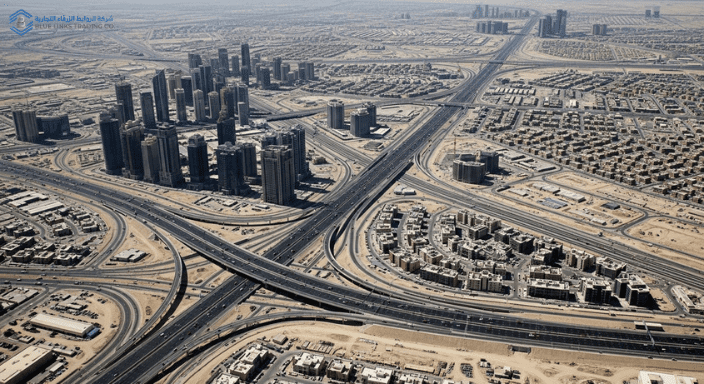
The scale, speed, and financial exposure of Saudi Arabia’s mega and giga projects have fundamentally changed the risk equation. Infrastructure developments spanning airports, rail networks, utilities, energy corridors, and smart cities operate under zero tolerance for disruption. In this environment, traditional excavation risks in Saudi mega projects are no longer isolated site incidents—they cascade into strategic consequences affecting timelines, budgets, and stakeholder confidence.
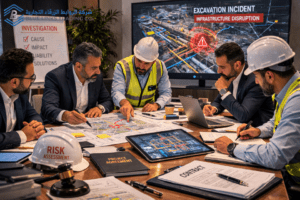
Senior project owners, consultants, and EPC leaders are now operating under unprecedented pressure. Compressed delivery timelines, heightened public visibility, and strict contractual frameworks mean that a single underground incident can trigger schedule overruns, contractual penalties, and reputational damage. These pressures have elevated excavation-related decisions from operational choices to board-level concerns tied directly to risk governance and project assurance.
This shift is not theoretical. It reflects a broader transformation in how large-scale infrastructure risk is assessed across the Kingdom. As highlighted in multiple infrastructure risk frameworks published by global development institutions such as the World Bank infrastructure risk analysis, early-stage construction activities increasingly carry disproportionate downstream impact when executed under legacy assumptions.
Understanding why excavation has become a strategic vulnerability—rather than how it is performed—is now essential for decision-makers responsible for safeguarding project outcomes in Saudi Arabia’s high-value, high-stakes development landscape.
The Expanding Risk Landscape in Saudi Mega Infrastructure
Saudi Arabia’s mega projects are being delivered within an environment defined by scale, speed, and systemic complexity. Unlike conventional infrastructure developments, these projects concentrate massive financial value, national visibility, and multi-agency coordination into tightly compressed timelines. Within this context, risk is no longer distributed evenly across project phases—early-stage activities now carry amplified downstream consequences.
One of the defining characteristics of this risk landscape is density. Modern Saudi cities and industrial zones contain layered underground networks built over decades of accelerated development. Utilities, transport systems, data infrastructure, and energy assets increasingly occupy the same subsurface corridors. As a result, traditional excavation risks in Saudi mega projects are magnified not by execution errors alone, but by the sheer probability of unintended interaction with critical assets.

This complexity places unprecedented pressure on project decision-makers. Excavation-related incidents are no longer evaluated solely in terms of repair cost or short-term delay. They are assessed based on their potential to disrupt interconnected systems, trigger regulatory intervention, and undermine public trust. In high-visibility projects, even minor disruptions can escalate into governance-level issues that demand executive intervention.
From a risk management perspective, this shift has forced project owners and EPC leaders to reconsider how early construction activities are classified and governed. As outlined in global infrastructure governance guidance published by the OECD infrastructure policy frameworks, systemic risk increases exponentially when legacy execution models are applied to projects operating at national or regional scale.
In Saudi Arabia’s current development cycle, excavation can no longer be treated as an isolated site function. It exists within a broader risk ecosystem where financial exposure, regulatory accountability, and schedule integrity are tightly coupled. Recognizing this expanded risk landscape is the first step toward understanding why legacy approaches struggle to scale within mega and giga project environments.
Hidden Financial Exposure Beyond Direct Excavation Costs
In Saudi mega projects, the true financial impact of excavation-related incidents rarely appears where decision-makers initially expect it. Direct repair costs represent only a fraction of the total exposure. The more consequential losses emerge through secondary and tertiary effects that ripple across project timelines, contractual structures, and interdependent work packages.
When excavation disrupts underground assets, the immediate response often focuses on containment and correction. However, traditional excavation risks in Saudi mega projects extend far beyond physical damage. Unplanned stoppages can immobilize entire construction zones, delay downstream contractors, and force costly resequencing of activities that were designed around tightly synchronized schedules.
These disruptions introduce a category of financial loss that is difficult to quantify but impossible to ignore. Idle labor, equipment downtime, extended site overheads, and accelerated recovery measures quietly accumulate. Over time, these indirect costs can exceed the original scope value of the affected work—without ever being attributed to excavation decisions in formal reporting.
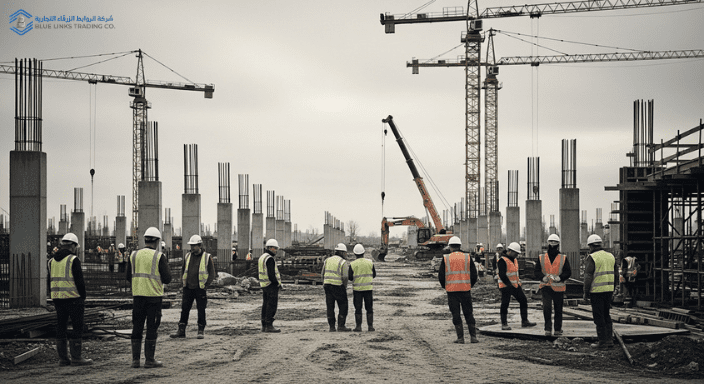
Contractual frameworks further amplify this exposure. Mega projects in the Kingdom typically operate under strict milestone-based delivery models, where delays cascade into liquidated damages, performance penalties, and strained commercial relationships. Excavation-related incidents therefore carry a disproportionate risk of triggering contractual consequences that far outweigh their apparent operational scale, a challenge frequently addressed within structured excavation risk management discussions at the governance level.
For project owners and EPC leadership, the critical issue is not the cost of fixing what went wrong underground, but the compounded financial volatility introduced into the project ecosystem. In environments where margins are closely monitored and public accountability is high, these hidden exposures transform excavation from a controllable activity into a material financial risk requiring executive oversight.
Schedule Disruption and Penalty Exposure in High-Stakes Projects
Schedule certainty is one of the most sensitive success factors in Saudi mega projects. Delivery timelines are not merely planning tools; they are contractual obligations tied to national priorities, public commitments, and multi-billion-dollar investment frameworks. In this environment, even short, localized delays can trigger disproportionate consequences across the entire project structure.

Excavation-related disruptions often occur at the earliest stages of construction, when dependencies between trades are most rigid. When work stops unexpectedly, downstream activities cannot simply be postponed without consequence. Interfaces between civil works, utilities, structural elements, and systems installation are tightly sequenced, meaning a single interruption can destabilize months of coordinated planning. This is where traditional excavation risks in Saudi mega projects evolve into schedule liabilities rather than isolated delays.
Unlike smaller developments, mega projects lack schedule elasticity. Recovery windows are limited, and acceleration strategies introduce their own cost and safety pressures. As a result, schedule overruns linked to excavation incidents frequently escalate into formal claims, renegotiations, and penalty exposure under milestone-driven contracts. These mechanisms transform time loss into measurable financial and legal risk.
Shutdowns compound this challenge further. In dense urban or industrial environments, excavation incidents may force temporary suspension of adjacent activities for safety, regulatory review, or coordination with asset owners. These shutdowns can immobilize multiple contractors simultaneously, magnifying delay impact and complicating accountability across the supply chain—a dynamic closely associated with large-scale supply chain management in mega projects.
For senior stakeholders, the critical concern is not whether delays can be recovered on paper, but whether the project can absorb disruption without breaching contractual thresholds or eroding delivery credibility. In Saudi Arabia’s zero-tolerance environment, excavation-related schedule risk has become a decisive factor in project assurance, governance reviews, and executive reporting.
Safety Liability and Public Infrastructure Accountability
In Saudi mega projects, safety incidents are no longer confined to site boundaries or internal reporting channels. The scale and visibility of these developments mean that any disruption affecting workers, adjacent assets, or public infrastructure immediately escalates into a matter of accountability. Excavation-related incidents, in particular, sit at the intersection of operational safety and executive responsibility.
When underground disruptions occur, the risk extends beyond physical harm. Damage to utilities, transport corridors, or service networks can expose project owners and contractors to regulatory scrutiny, public inquiry, and reputational consequences. Within this environment, traditional excavation risks in Saudi mega projects translate into liability exposure that reaches far beyond standard health and safety considerations.
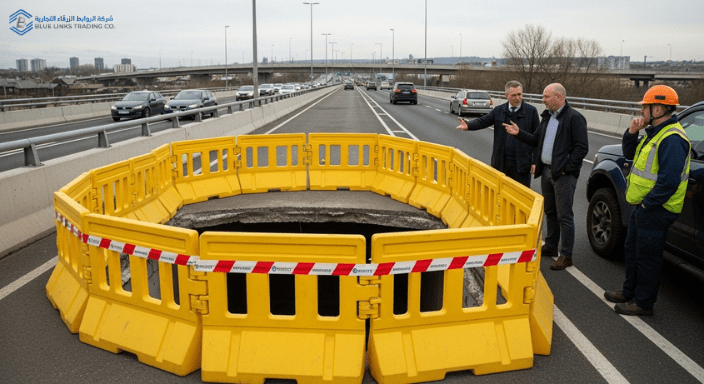
This shift has altered how responsibility is assigned. Senior leadership is increasingly expected to demonstrate foresight, governance, and risk anticipation—not just compliance after the fact. Excavation incidents that impact public services or adjacent developments raise questions about decision-making frameworks, approval processes, and the adequacy of early risk classification.
The challenge is compounded by the interconnected nature of modern infrastructure. Urban expansion, smart city development, and industrial clustering mean that excavation-related disruptions can affect multiple stakeholders simultaneously. These ripple effects complicate incident attribution and heighten expectations for proactive risk governance, rather than reactive mitigation.
As a result, safety exposure linked to excavation is no longer assessed solely through incident rates or compliance metrics. It is evaluated through its potential to trigger executive escalation, regulatory engagement, and long-term trust erosion. In Saudi Arabia’s high-stakes development landscape, this reality has reframed excavation as a matter of strategic accountability rather than site-level control.
Why Legacy Excavation Approaches Fail to Scale
Legacy excavation approaches were developed for projects operating within predictable boundaries—limited scope, contained environments, and manageable interdependencies. Saudi mega projects operate under fundamentally different conditions. Scale, integration, and national impact have altered the tolerance thresholds for uncertainty, making legacy assumptions increasingly misaligned with current delivery realities.

The primary limitation of traditional approaches lies in their inability to adapt to compounded risk environments. Mega projects are not linear systems; they are networks of interdependent assets, stakeholders, and timelines. In such systems, localized disruptions do not remain local. This is why traditional excavation risks in Saudi mega projects escalate rapidly, even when initial incidents appear operationally minor.
Another critical factor is decision velocity. Saudi mega projects demand rapid execution aligned with national development milestones. Legacy excavation models were not designed to operate under continuous executive scrutiny or real-time governance expectations. When early-stage activities fail to align with modern risk oversight frameworks, gaps emerge between execution and accountability.
From a governance perspective, scaling failure is often linked to visibility rather than capability. Traditional excavation practices lack the structural alignment required for proactive risk anticipation at scale. As a result, risks are identified reactively, after disruption has already occurred, rather than being incorporated into forward-looking decision frameworks commonly discussed within predictive maintenance and early-risk anticipation contexts.
In high-value infrastructure environments, scalability is not measured by how fast work progresses on site, but by how effectively risk is governed as complexity increases. Legacy excavation approaches struggle not because they are ineffective in isolation, but because they are incompatible with the systemic risk demands of Saudi Arabia’s largest and most consequential projects.
Executive Accountability in a Zero-Tolerance Environment

Saudi Arabia’s mega projects represent a new class of infrastructure development—one where scale, speed, and national visibility leave no margin for avoidable disruption. Within this context, excavation can no longer be viewed as a routine construction function managed exclusively at the site level. It has become a strategic variable capable of influencing financial exposure, schedule integrity, and institutional credibility.
The growing impact of traditional excavation risks in Saudi mega projects reflects a broader shift in how risk is distributed across modern infrastructure programs. Early-stage decisions now carry amplified downstream consequences, and responsibility increasingly rests with those who define governance frameworks, approve execution models, and set risk tolerance thresholds—not only with those who execute work on the ground.
For project owners, consultants, and EPC leadership, the central question is no longer whether excavation can be completed, but whether the decisions surrounding it align with the realities of high-density environments, interconnected systems, and zero-tolerance delivery mandates. In this setting, excavation-related disruptions are interpreted not as isolated failures, but as indicators of misaligned risk classification and oversight.
As Saudi Arabia continues to deliver projects of unprecedented scale and complexity, accountability frameworks will continue to evolve. Activities once considered operational details are now subject to executive scrutiny because their failure potential exceeds acceptable thresholds. Excavation sits squarely within this category—where strategic awareness, governance discipline, and decision accountability define success long before construction begins.
Recognizing excavation as a board-level risk factor is not a matter of methodology or technology. It is a matter of leadership responsibility in an environment where the cost of disruption is measured not only in time and money, but in national confidence and long-term impact.