
Procurement vs Purchasing: Key Differences That Protect Project Success
Why Understanding Procurement vs Purchasing Matters

In major industrial and infrastructure projects, the difference between Procurement vs Purchasing is not just a matter of terminology. It can influence project timelines, supplier reliability, cost control, technical compliance, and the overall success of delivery.
Traditional purchasing usually focuses on the act of buying a good or service. It is often transactional, short-term, and centered around price, availability, and purchase order completion. This approach may work well for routine business operations, but it can become risky when applied to complex projects that depend on technical specifications, supplier coordination, logistics planning, and delivery certainty.
Project procurement, on the other hand, is a broader and more strategic process. It connects supplier selection, sourcing, commercial coordination, risk management, logistics, expediting, and delivery control into one structured framework. For companies working in Saudi Arabia and the GCC, this distinction becomes even more important as industrial development, infrastructure expansion, and technical project requirements continue to grow under the wider transformation supported by Saudi Vision 2030.
This is where a structured project procurement process becomes essential. It helps project teams move beyond simple buying decisions and focus on the bigger question: will this supplier, product, shipment, and delivery plan protect the project from delays, cost escalation, and execution risk?
For Blue Links Trading Company, procurement is not treated as a simple purchasing activity. It is part of a wider supply chain approach that supports industrial projects, technical equipment sourcing, supplier coordination, and reliable delivery across Saudi Arabia and the GCC.
Key Takeaways
- Purchasing is transactional: it focuses on buying goods and services, issuing purchase orders, and completing short-term requirements.
- Procurement is strategic: it manages sourcing, supplier relationships, logistics, risk management, and long-term project value.
- Purchasing is a subset of procurement: purchasing is one part of the entire procurement process, not the full function.
- Project procurement protects delivery: it helps reduce procurement delays, supplier failure, logistics disruption, and technical mismatches.
- Procurement vs Purchasing matters most in complex projects: especially when equipment, customs, lead times, site readiness, and supplier performance affect execution.
- Effective procurement supports better supply chain performance: it aligns technical needs, supplier capability, and logistics planning before problems appear on site.
What Is Purchasing?

Purchasing is the act of buying the goods and services a company needs to support daily operations, project execution, maintenance, or internal business activities. In simple terms, purchasing focuses on completing a buying transaction in the most practical and cost-effective way.
In many companies, the purchasing team is responsible for receiving a purchase requisition, requesting supplier quotations, comparing prices, issuing a purchase order, and confirming that the required good or service has been delivered. This makes purchasing an important operational function, especially when the requirement is clear, repeated, and low-risk.
However, purchasing is usually more transactional than strategic. It often starts after the need has already been defined. The buyer may not always be involved in supplier qualification, technical review, logistics planning, risk management, or long-term supplier relationship management.
The Purchasing Process in Business Operations
The purchasing process is commonly used for routine business operations where the product or service is already known. For example, a company may need office supplies, standard spare parts, basic tools, consumables, or simple maintenance materials. In these cases, the goal is usually to acquire the required item quickly, at a fair price, and with acceptable quality.
A typical purchasing process may include the following steps:
- Identifying the internal need for a good or service.
- Creating a purchase requisition from the requesting department.
- Requesting quotations from available suppliers.
- Comparing price, availability, and delivery time.
- Issuing a purchase order to the selected supplier.
- Receiving the goods and services.
- Closing the transaction after delivery and payment confirmation.
This workflow is practical and necessary. Every organization needs a purchasing process to keep operations moving. The issue appears when a company treats complex project needs as if they were simple purchasing activities.
When Traditional Purchasing Is Enough
Traditional purchasing is often enough when the requirement is simple, low-risk, and clearly defined. If a company needs standard goods with no complex technical specifications, limited supplier risk, and no critical delivery pressure, purchasing can be the right approach.
For example, buying standard office materials, common replacement parts, or repeated consumables may not require a full procurement strategy. The purchasing team can manage the process efficiently through supplier quotes, purchase orders, and delivery confirmation.
But when the requirement involves technical equipment, industrial materials, international sourcing, customs documentation, long lead times, or strict project deadlines, purchasing alone may not provide enough control. In these situations, the organization needs a broader procurement function that can evaluate suppliers, manage risks, coordinate logistics, and protect the project schedule.
What Is Procurement?
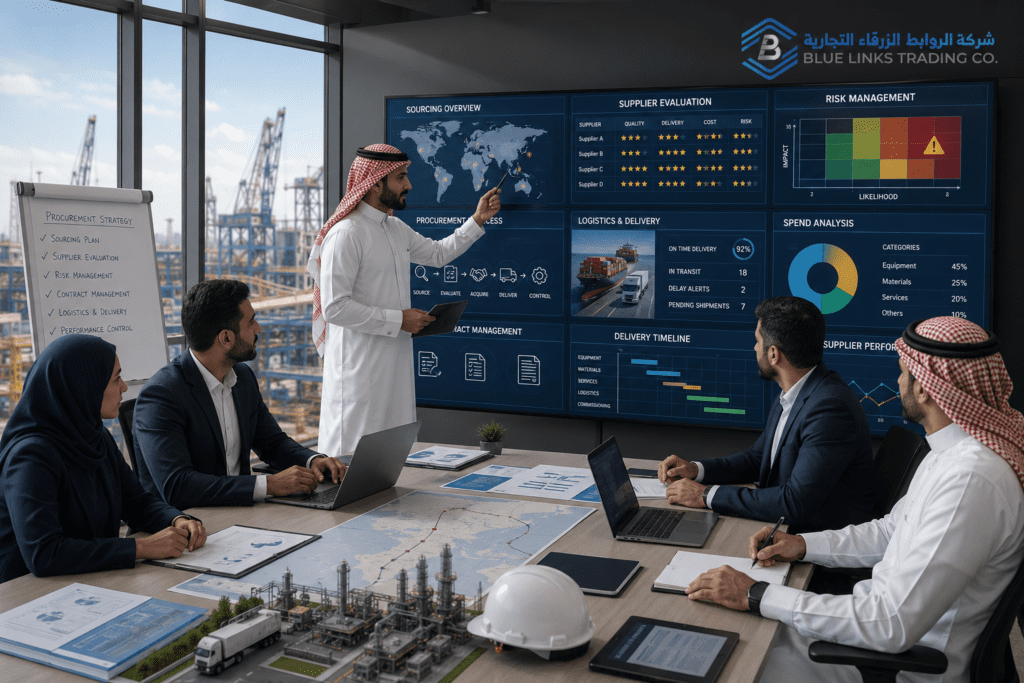
Procurement is a broader strategic process that manages how an organization sources, evaluates, acquires, delivers, and controls the goods and services needed for its projects or operations. Unlike purchasing, procurement does not begin at the purchase order stage. It begins earlier, when the company studies what it needs, why it needs it, which source can provide it, and how the decision will affect cost, quality, delivery, and risk.
In industrial and infrastructure projects, procurement involves more than choosing a supplier. It may include technical requirement analysis, supplier prequalification, commercial negotiation, logistics planning, documentation review, expediting, customs coordination, and delivery monitoring. This is why procurement is a strategic process that directly supports project continuity.
For project-based organizations, procurement helps connect technical teams, suppliers, logistics providers, finance teams, and site operations. The goal is not only to acquire goods or services, but to make sure the right solution reaches the right location at the right time, with the right specifications and acceptable risk.
The Procurement Process as a Strategic Process
The procurement process usually starts before any supplier is contacted. A procurement manager or procurement team first needs to understand the project requirement, technical specifications, delivery schedule, approved budget, supplier market, and operational risks.
In many cases, procurement specialists also need to evaluate whether a supplier can actually meet the project’s requirements. A low price may look attractive at the beginning, but if the supplier cannot meet the required quality, documentation, production timeline, or delivery conditions, the project may face delays later.
This is why supplier selection in industrial projects is one of the most important parts of effective procurement. The decision should consider technical capability, delivery history, production capacity, communication quality, compliance, and logistics feasibility, not price alone.
A strong procurement process may include:
- Analyzing project requirements and technical specifications.
- Identifying potential suppliers and sources.
- Evaluating supplier capability, quality, and reliability.
- Negotiating commercial and delivery terms.
- Managing purchase orders as part of the wider procurement cycle.
- Monitoring production, shipping, documentation, and delivery.
- Managing procurement risks before they affect the project site.
Why Procurement Is Broader Than Purchasing
Purchasing is a subset of procurement. It handles the act of buying, while procurement manages the entire procurement process around that buying decision. This distinction is especially important for companies working with technical equipment, industrial materials, and project-critical supplies.
Purchasing focuses on completing the transaction. Procurement focuses on long-term value, supplier relationships, risk management, supply chain reliability, and project outcomes. In other words, purchasing may answer the question: “How do we buy this item?” Procurement answers a larger question: “How do we secure the right solution without exposing the project to unnecessary risk?”
This is the practical difference between procurement and purchasing. One is mainly transactional. The other is strategic. Both are important, but they are not interchangeable in complex projects.
Procurement vs Purchasing: Key Differences Explained
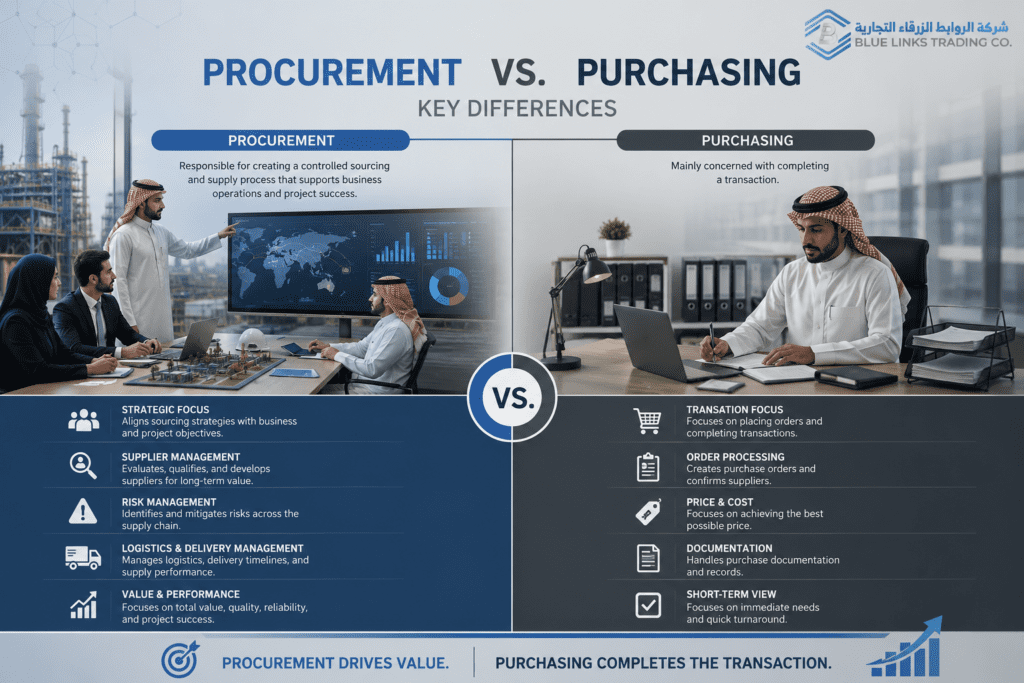
The most important difference in Procurement vs Purchasing is the level of responsibility each function carries. Purchasing is mainly concerned with completing a transaction. Procurement is responsible for creating a controlled sourcing and supply process that supports business operations and project success.
In simple terms, purchasing handles the act of buying, while procurement ensures that buying decisions are aligned with quality, cost, supplier performance, logistics, and long-term value. This is why procurement and purchasing are often used together, but they should not be treated as the same function.
| Comparison Point | Traditional Purchasing | Project Procurement |
|---|---|---|
| Main Objective | Buy a required good or service. | Secure the right solution for the project. |
| Scope | Focused on price, order placement, and delivery confirmation. | Covers sourcing, supplier evaluation, logistics, expediting, and risk management. |
| Process | Shorter and more transactional. | Broader, structured, and connected to the entire procurement process. |
| Supplier Relationship | Often based on immediate need and availability. | Built around supplier relationships, capability, reliability, and long-term value. |
| Cost Focus | Usually focuses on purchase price. | Considers total cost, delivery risk, quality, logistics, and project impact. |
| Quality Control | May be limited to basic product acceptance. | Includes specification matching, documentation, supplier capability, and compliance. |
| Risk Management | Mostly reactive when problems appear. | Proactive and designed to reduce risks before they affect the project. |
| Supply Chain Role | Limited connection to the wider supply chain. | Directly supports supply chain management, logistics coordination, and delivery planning. |
| Timeline Impact | May not fully control supplier lead times or delivery risks. | Tracks critical milestones to protect project delivery timelines. |
| Best Use Case | Routine goods, low-risk items, and repeat purchases. | Industrial projects, technical equipment, infrastructure materials, and critical project needs. |
This table shows that the key differences are not only about definitions. They are about how each function affects execution. A purchasing team may successfully complete a purchase order, but if supplier capability, documentation, logistics, or delivery timing are not controlled, the project may still face serious disruption.
For that reason, companies working in industrial and infrastructure sectors often need procurement strategies that go beyond the basic purchasing process. They need a structured approach that connects sourcing, supplier evaluation, commercial coordination, and delivery control into one disciplined system.
Procurement Process vs Purchasing Process
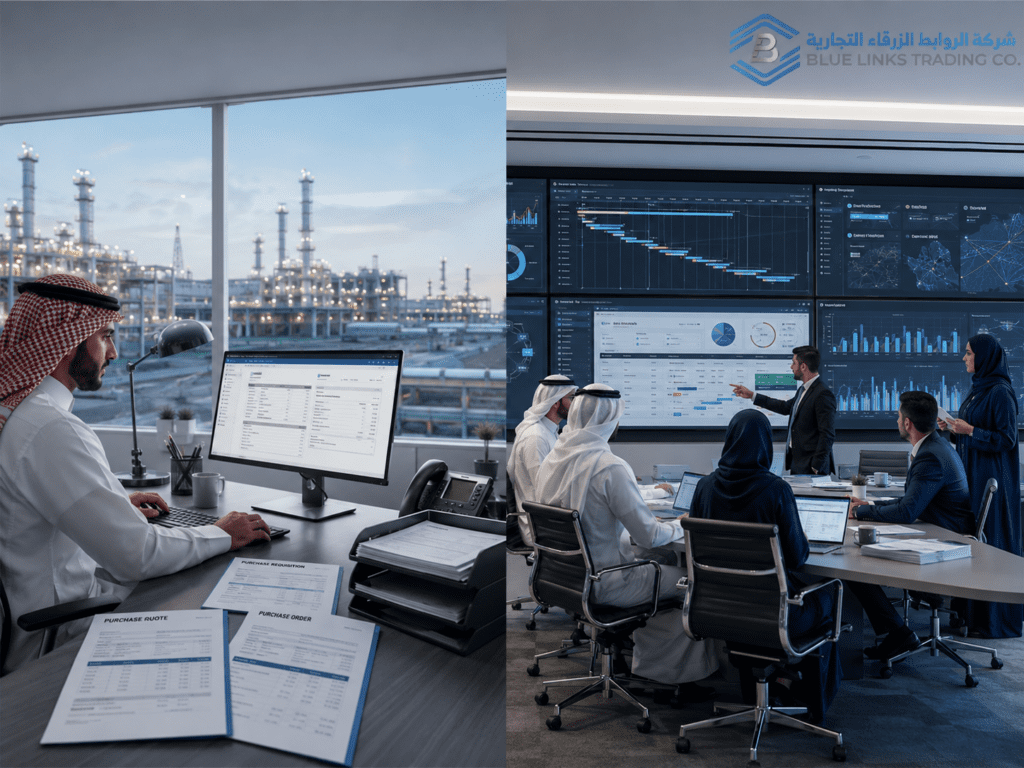
To understand the difference between procurement and purchasing in a practical way, it is helpful to look at how each process works. The purchasing process is usually shorter and more focused on completing a transaction, while the procurement process is wider and connected to planning, supplier evaluation, logistics, and project risk control.
In routine business operations, both processes may appear similar because they eventually lead to acquiring goods or services. But in project environments, the difference becomes clear. Purchasing may complete the order, while procurement protects the path from requirement definition to final delivery.
Steps in the Purchasing Process
The steps in the purchasing process usually begin after the internal need has already been identified. At this stage, the purchasing team is expected to move quickly, compare available options, and complete the buying cycle.
- Identify the need: A department requests a good or service needed for daily operations or a specific task.
- Create a purchase requisition: The request is documented internally for approval.
- Request supplier quotations: The purchasing team contacts available suppliers to compare prices and delivery times.
- Select the supplier: The choice is often based on price, availability, and basic quality expectations.
- Issue the purchase order: The company formally confirms the order with the supplier.
- Receive goods and services: The requested item is delivered and checked against the purchase order.
- Close the transaction: The invoice is processed, and the purchase is completed.
This purchasing workflow is useful, simple, and efficient when the item is standard. But it may not be enough when the required product is technically complex, imported from another country, customized for a project, or directly connected to a critical delivery milestone.
Steps in the Procurement Process
The steps in the procurement process are more detailed because procurement involves planning before buying. In project procurement, the team must understand the technical, commercial, operational, and logistical requirements before any purchase order is issued.
- Analyze project requirements: The procurement team studies what the project needs, why it is needed, and how it will affect execution.
- Define technical specifications: Requirements are clarified to avoid supplier misunderstanding or product mismatch.
- Source qualified suppliers: The team identifies suppliers capable of meeting the project’s technical and delivery needs.
- Evaluate supplier capability: Supplier reliability, production capacity, documentation, compliance, and delivery history are reviewed.
- Negotiate terms: Commercial terms, delivery schedules, payment conditions, warranty, and responsibilities are agreed.
- Manage the procurement cycle: Purchase orders, documentation, approvals, production updates, and milestones are monitored.
- Coordinate logistics: Shipping, customs, transport, and local delivery plans are managed before delays occur.
- Monitor delivery and risk: The team tracks supplier progress and handles risks before they affect the project schedule.
This wider process is one reason many companies rely on procurement logistics coordination when project materials or technical equipment must move across suppliers, shipping routes, customs points, and project sites.
How Procurement and Purchasing Affect the Supply Chain

Purchasing affects the supply chain by completing the immediate transaction. It helps the business obtain the good or service it needs. But procurement affects the supply chain at a deeper level because it shapes supplier relationships, delivery reliability, logistics planning, and risk management.
In a simple purchase, the main question may be: “Can we get this item at the right price?” In project procurement, the question becomes broader: “Can this supplier deliver the correct item, at the required quality, within the project timeline, through a logistics plan that will not disrupt execution?”
This is especially important in Saudi and GCC projects where industrial development, infrastructure expansion, and technical equipment supply often depend on reliable coordination between international suppliers, local teams, logistics providers, and project stakeholders.
Global studies such as the World Bank Logistics Performance Index show how logistics performance and trade efficiency can influence supply chain reliability. For project teams, this means that procurement decisions should not stop at supplier price. They must also consider documentation, shipping routes, customs clearance, delivery readiness, and site requirements.
Effective procurement helps companies build stronger supply chain management because it connects the buying decision to the full delivery journey. This is where procurement becomes more than a commercial function. It becomes a project protection function.
Examples of Procurement and Purchasing in Real Projects
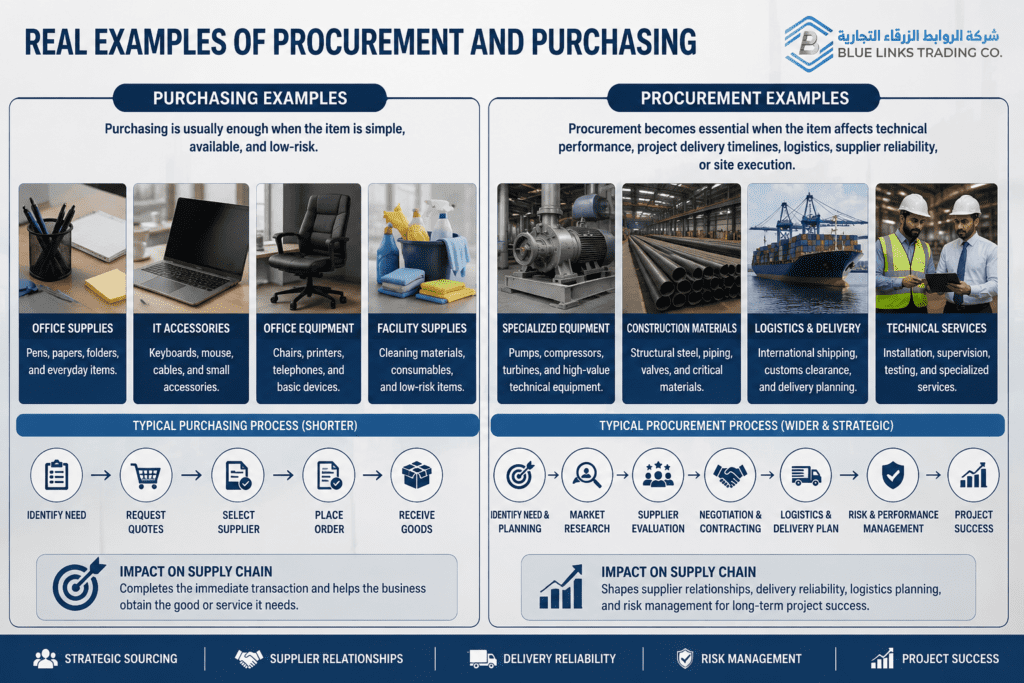
Examples of procurement and purchasing make the distinction easier to understand. In many organizations, both functions may work together, but each one has a different level of responsibility and impact on the project.
Purchasing is usually enough when the item is simple, available, and low-risk. Procurement becomes essential when the item affects technical performance, project delivery timelines, logistics, supplier reliability, or site execution.
Example of Traditional Purchasing
A company may need to buy standard office materials, basic tools, common spare parts, or repeat consumables. In this case, the purchasing team can request quotations, compare prices, issue a purchase order, receive the goods, and close the transaction.
The risk level is usually low because the item is not technically complex, the supplier options are widely available, and a short delay may not seriously affect a major project milestone. Here, purchasing is practical because the main objective is to complete the act of buying efficiently.
For routine goods and services, a simple purchasing process can support daily business operations without requiring a full procurement strategy. The purchasing team focuses on price, availability, and delivery confirmation.
Example of Project Procurement
Now consider a project that requires specialized industrial equipment, technical materials, or machinery sourced from international suppliers. The requirement may involve strict technical specifications, long lead times, shipping documentation, customs clearance, site delivery planning, and coordination with the project schedule.
In this situation, the buying decision cannot be treated as a simple purchase. The procurement team must evaluate supplier capability, review technical compliance, confirm production timelines, coordinate logistics, monitor documentation, and manage potential delays before they affect the project site.
This is where industrial procurement in Saudi Arabia becomes more than a commercial activity. It becomes a structured approach to securing critical goods and services while protecting project continuity, quality, and delivery certainty.
How the Wrong Approach Can Delay Delivery
Problems often happen when a complex procurement requirement is handled as a simple purchasing activity. A supplier may offer a lower price but fail to meet the required delivery date. A product may be ordered without complete technical review. Shipping may be arranged too late. Documentation may be incomplete. Customs clearance may take longer than expected.
Each issue may look small in isolation, but together they can create procurement delays that affect site readiness, installation schedules, contractor coordination, and final project delivery.
This is why project teams must understand the differences between procurement vs purchasing before choosing the right approach. The question is not only how to buy the item. The question is how to ensure that the item supports the project without creating avoidable risk.
Common Challenges in Procurement and Purchasing
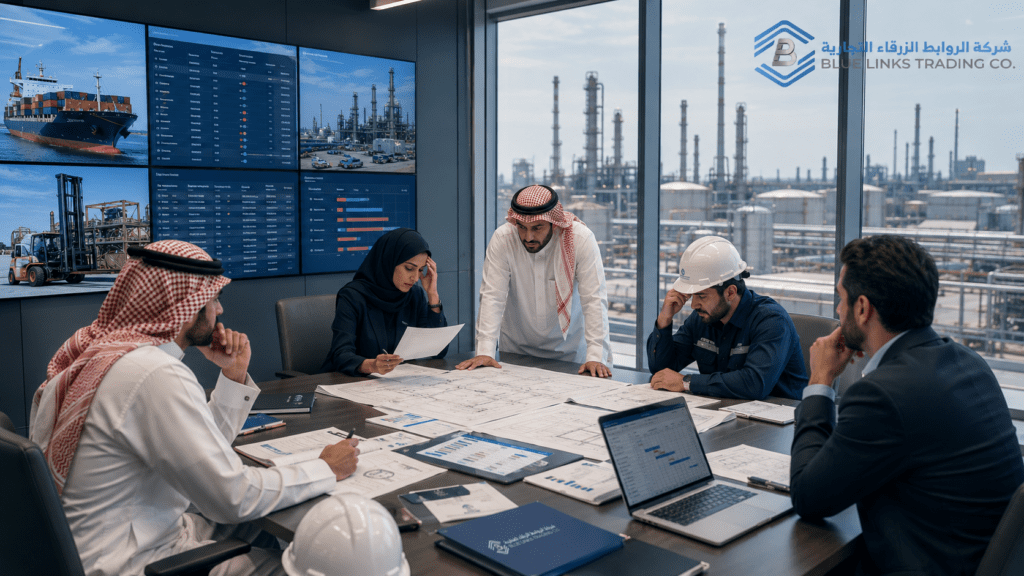
Even experienced companies can face challenges in procurement and purchasing when processes are unclear or responsibilities overlap. These challenges become more serious in industrial and infrastructure projects where timing, quality, and supplier performance directly affect execution.
Price-Only Decisions
One of the most common mistakes is choosing a supplier mainly because they offer the lowest price. While cost control is important, the cheapest option may create higher costs later if the supplier fails to meet specifications, delivery schedules, documentation requirements, or quality expectations.
Effective procurement looks beyond the purchase price. It considers total project value, supplier reliability, logistics risk, and the cost of delay or rework.
Weak Supplier Relationships
Supplier relationships are not only useful during negotiation. They become critical when timelines are tight, documents need correction, production updates are required, or unexpected changes appear.
Strong supplier relationship management helps procurement professionals maintain communication, solve issues faster, and protect the delivery plan. Weak relationships, on the other hand, often lead to slow responses and limited visibility.
Unclear Technical Requirements
Many procurement risks begin with unclear specifications. If the project team does not define the required good or service accurately, the supplier may provide an item that appears acceptable commercially but fails technically.
This can lead to replacement costs, approval delays, or installation problems. In technical projects, procurement ensures that commercial decisions are aligned with engineering requirements before the purchase order is issued.
Delivery Delays and Poor Follow-Up
A purchase order does not guarantee successful delivery. Without follow-up, production tracking, shipping coordination, and milestone monitoring, the procurement team may discover delays too late.
For critical project materials, procurement expediting helps monitor supplier progress and accelerate actions when timing becomes sensitive. This can reduce the chance of late delivery affecting the project schedule.
Logistics and Customs Issues
International sourcing can involve freight planning, export documents, import approvals, customs clearance, port handling, and local transportation. If these steps are not planned early, even a successful purchase can become a delayed delivery.
That is why procurement and purchasing processes must be connected to logistics planning, especially when goods are imported for Saudi and GCC projects.
Best Practices for Effective Procurement and Purchasing
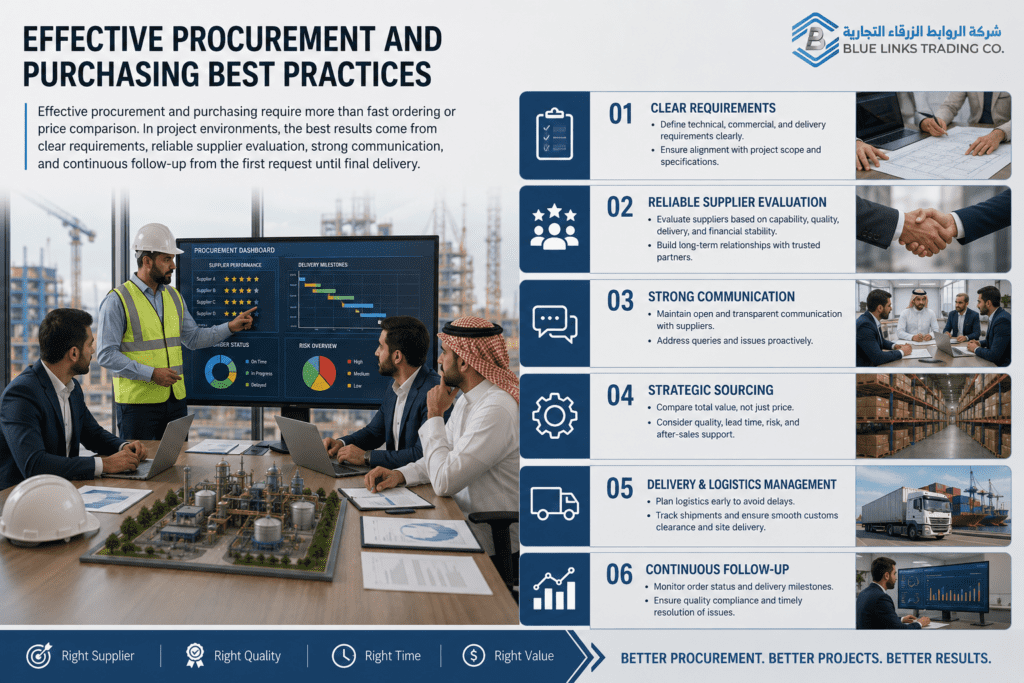
Effective procurement and purchasing require more than fast ordering or price comparison. In project environments, the best results come from clear requirements, reliable supplier evaluation, strong communication, and continuous follow-up from the first request until final delivery.
When procurement and purchasing teams work together properly, they help reduce confusion, improve supplier performance, and protect the project from avoidable delays. The goal is not to make the process more complicated. The goal is to make every buying decision more controlled, traceable, and aligned with project needs.
Define Technical Requirements Before Supplier Selection
Before a company contacts suppliers, it should define the required specifications clearly. This includes product type, technical standards, size, capacity, material, compliance requirements, delivery conditions, documentation, and any site-specific needs.
Clear specifications reduce misunderstandings and help suppliers provide accurate quotations. They also help the procurement team compare offers fairly instead of comparing prices for different levels of quality or capability.
Evaluate Suppliers Beyond Price
Supplier evaluation should include more than cost. A supplier may offer an attractive price but lack the production capacity, documentation quality, delivery discipline, or technical understanding needed for a critical project.
A stronger approach considers supplier history, communication, compliance, after-sales support, logistics feasibility, and the ability to respond when project conditions change. This is one reason procurement risks in Saudi Arabia should be assessed early, especially in projects with imported materials, specialized equipment, or strict delivery milestones.
Align Procurement Decisions With Project Schedules
Procurement should never operate separately from the project schedule. Delivery dates, production lead times, shipping windows, customs clearance, and site readiness must all be reviewed before the final supplier decision is made.
When procurement decisions are aligned with project timelines, teams can avoid last-minute pressure, rushed logistics, and emergency alternatives that increase cost and reduce control.
Improve Supplier Relationship Management
Strong supplier relationships help create better visibility and faster problem-solving. This is especially important when procurement involves long lead times, international sources, technical equipment, or changing project requirements.
Suppliers are not just vendors in a project procurement environment. They become part of the project supply chain. A good supplier relationship can help improve delivery confidence, documentation accuracy, and response time when issues appear.
Use Procurement Strategies for Critical Materials
Not every purchase needs the same level of planning. Simple purchases can follow a standard purchasing workflow. Critical materials, however, require procurement strategies that consider risk, schedule sensitivity, quality requirements, and supplier reliability.
For example, project-critical items may need early sourcing, supplier backup options, milestone tracking, expediting, and logistics coordination. These practices help protect the project from delays that may not be visible at the purchase order stage.
Track Purchase Orders and Delivery Milestones
A purchase order is only one step in the process. After it is issued, the procurement team should monitor production updates, documentation status, shipping progress, customs requirements, and expected delivery dates.
This follow-up helps identify delays early. It also gives project teams enough time to adjust schedules, coordinate site readiness, or take corrective action before a delay becomes a major disruption.
When Should a Company Use Procurement or Purchasing?

Choosing between procurement or purchasing depends on the level of risk, complexity, and project impact. Both functions are important, but they are not suitable for the same situations.
The main question is simple: is the company buying a standard item, or is it securing a solution that can affect project cost, quality, delivery, and execution?
When Purchasing Is the Right Choice
Purchasing is the right choice when the requirement is clear, simple, repeatable, and low-risk. It works well when supplier options are available, specifications are standard, and delivery delays will not create serious project consequences.
Examples include routine office supplies, common consumables, simple spare parts, basic tools, or low-value goods and services used in daily business operations.
In these cases, the purchasing team can focus on comparing prices, issuing a purchase order, receiving goods, and closing the transaction efficiently.
When Project Procurement Becomes Essential
Project procurement becomes essential when the requirement is technical, customized, imported, high-value, or directly connected to project delivery. It is also necessary when supplier failure, logistics delays, or documentation issues can affect the project schedule.
Companies should use procurement instead of simple purchasing when they need specialized equipment, industrial materials, cross-border sourcing, customs coordination, supplier qualification, or delivery planning for critical project milestones.
This is especially relevant for construction, infrastructure, energy, utilities, oil and gas, smart-city, and industrial projects across Saudi Arabia and the GCC, where procurement decisions can influence the success of the entire project supply chain.
How to Choose the Right Approach
If the item is simple and easily replaceable, purchasing may be enough. If the item requires technical review, supplier coordination, logistics planning, or schedule protection, procurement is the safer approach.
In practical terms, companies should treat purchasing as the execution of a buying transaction, while procurement should be used when the decision requires strategy, risk management, and long-term project value.
How Blue Links Trading Company Supports Smarter Procurement
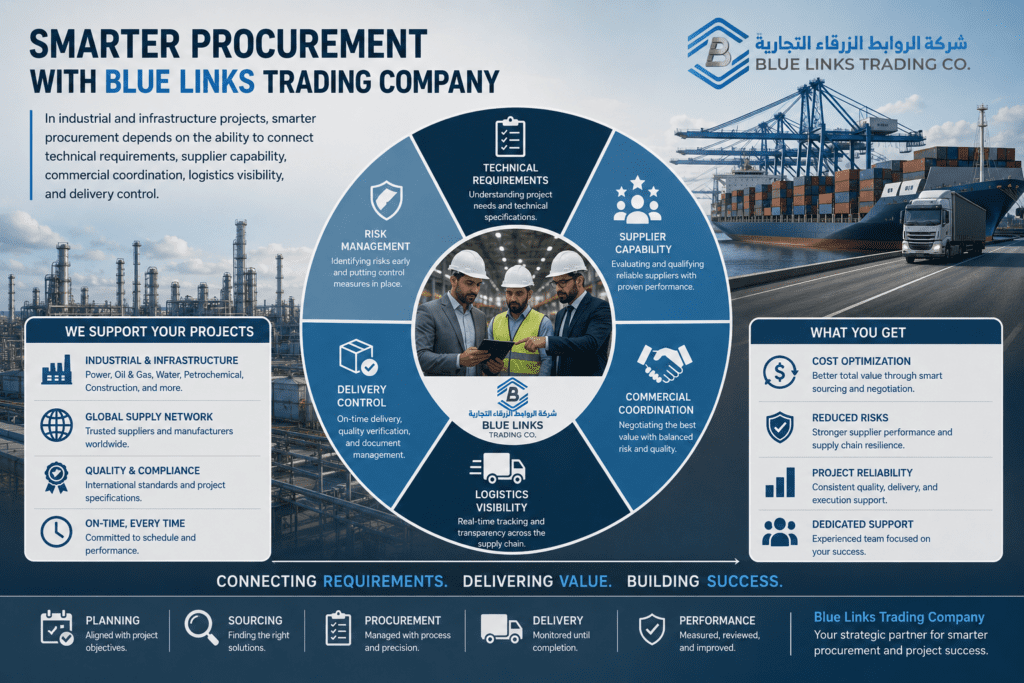
In industrial and infrastructure projects, smarter procurement depends on the ability to connect technical requirements, supplier capability, commercial coordination, logistics visibility, and delivery control. This is the area where Blue Links Trading Company positions its role as a strategic procurement and industrial supply partner for Saudi and GCC markets.
The company’s work is not limited to providing materials or technical equipment. Its approach is based on understanding the requirement, identifying suitable sources, coordinating with suppliers, following up on orders, and supporting delivery in a way that helps project teams reduce uncertainty.
From Supplier Analysis to Delivery Coordination
A strong procurement function starts with supplier analysis. Before a company places an order, it needs to know whether the supplier can meet the required quality, quantity, delivery timeline, documentation standards, and technical expectations.
Blue Links Trading Company supports this approach by focusing on supplier coordination, market sourcing, order management, and communication across the procurement cycle. This helps reduce the gap between what the project needs and what the supplier can realistically deliver.
For project teams, this matters because procurement is not only about getting a product. It is about protecting the project from late delivery, poor quality, wrong specifications, and weak supplier response.
Supporting Industrial and Infrastructure Projects in Saudi Arabia
Saudi Arabia and the GCC continue to invest in industrial development, infrastructure expansion, energy projects, utilities, transportation, and smart-city environments. These projects require reliable procurement practices because delays in materials or equipment can affect multiple contractors, schedules, and site operations.
Structured procurement also supports stronger supply chain management in mega projects, where each supplier, shipment, document, and delivery milestone must be aligned with the broader project plan.
In this context, Blue Links Trading Company’s focus on project procurement, logistics monitoring, technical supply, and supplier relationships helps clients move beyond basic purchasing and toward a more reliable procurement model.
Why Strategic Procurement Creates Long-Term Value
Strategic procurement creates value because it looks at the full impact of a decision, not just the immediate purchase price. A supplier with a slightly higher price may provide better documentation, stronger technical support, faster communication, and more reliable delivery. In many projects, these factors can protect far more value than a small saving at the purchasing stage.
This is why procurement focuses on long-term value. It helps companies build stronger supplier relationships, reduce operational risk, improve delivery confidence, and make procurement decisions that support project success.
For companies working in Saudi Arabia and the GCC, stronger procurement also supports better resilience in the supply chain. It helps project teams plan earlier, communicate better, and respond faster when challenges appear.
🟦 Frequently Asked Questions (FAQ)
⚡ Conclusion: Purchasing Buys Products, Procurement Protects Projects
The difference between Procurement vs Purchasing may seem simple in definition, but its impact on project success is significant. Purchasing focuses on the act of buying goods or services, while procurement is the strategic process that manages sourcing, supplier selection, commercial coordination, logistics, risk management, and delivery control.
In routine business operations, traditional purchasing can be enough. But in industrial, infrastructure, energy, construction, and technical projects, the risk is much higher. A poor buying decision can delay delivery, increase costs, affect quality, and disrupt project execution.
This is why procurement should not be treated as a theoretical business function. It is a practical project-control tool that helps companies protect timelines, budgets, supplier performance, technical compliance, and supply chain continuity.
The cheapest purchase is not always the safest decision. The right procurement approach is the one that delivers the correct goods and services, from the right supplier, through the right logistics plan, at the right time, and with the right level of control.
For companies operating in Saudi Arabia and the GCC, where project schedules and industrial requirements demand precision, structured procurement can reduce uncertainty and support stronger delivery performance. Explore how modern
industrial procurement in Saudi Arabia
can help project teams move beyond transactional buying and build more reliable supply chain decisions.
Blue Links Trading Company supports project procurement through supplier coordination, technical supply, logistics monitoring, expediting, and practical knowledge of Saudi and GCC industrial markets. This approach helps clients turn procurement complexity into a more controlled and reliable project delivery process.
If your next project depends on quality, timing, supplier reliability, and execution confidence, the right results begin with stronger procurement decisions before the purchase order is issued.
With Blue Links Trading Company, you gain more than a supplier—you gain a strategic procurement partner capable of supporting supplier selection, logistics coordination, risk reduction, and reliable project delivery across Saudi Arabia and the GCC.
Blue Links Trading Company — turning procurement decisions into project certainty.